INFORMATION:
- The product (substance) is not a food or dietary supplement, and is not suitable for human consumption.
- Keep out of the reach of children.
- Keep the container tightly closed.
- Store in a dry, cool, shaded place; protect from moisture.
- Store only in original container.
- Avoid contact during pregnancy and lactation.
- Consult a physician if you feel unwell or have adverse reactions related to contact.
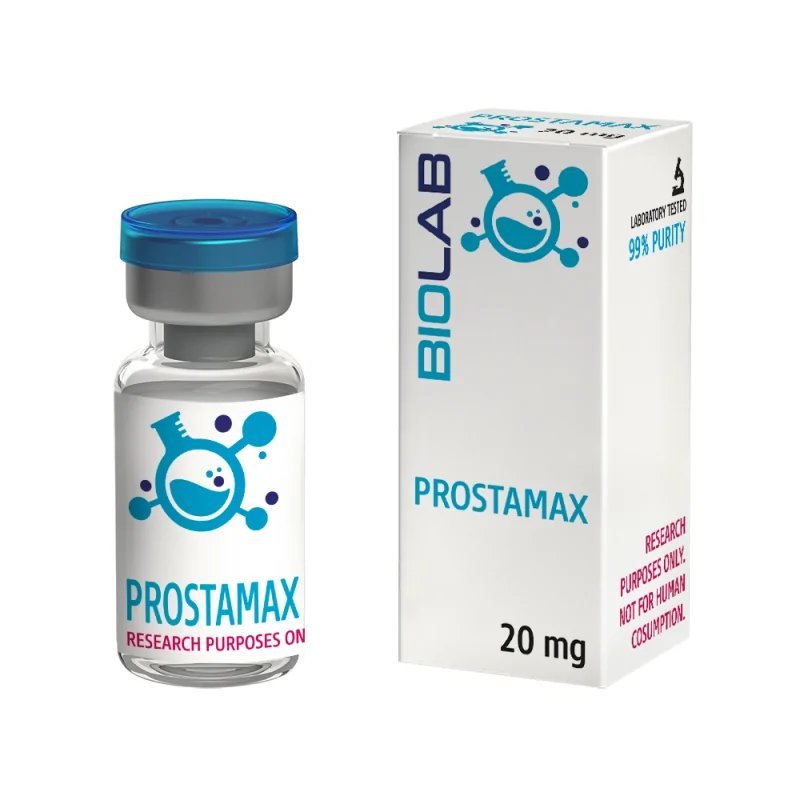
Prostamax – Biochemical Profile and Research Directions
Prostamax is a synthetic Khavinson peptide investigated in laboratory and preclinical settings for tissue-oriented regulatory effects, including models involving prostate-derived cells and immune-cell readouts. The peptide has been reported in experimental literature to influence lymphocyte-related readouts and alter DNA expression patterns in other tissues. It is discussed as a peptide with a broader spectrum of action, associated with changes in chromatin organisation (e.g., heterochromatin decondensation) in multiple cell types under controlled experimental conditions. Preclinical models indicate that Prostamax has been evaluated in models of prostate tissue inflammation and remodelling.
Preclinical Models of Inflammation and Remodelling
In the literature, prostate-focused experimental models are used to assess endpoints such as tissue swelling, vascular congestion, immune-cell infiltration, and extracellular-matrix remodelling. Preclinical studies report that exposure to Prostamax was associated with changes in selected histological and cellular markers over the course of the experiment. These observations are model-dependent and do not constitute evidence of therapeutic efficacy in humans. Wszelkie informacje mają charakter informacyjny (research-only) i nie stanowią opisu działania produktu u ludzi ani zaleceń dotyczących użycia. No dosing, administration routes, or human-use directions are provided.
Cellular Mechanisms and Molecular Observations
Beyond prostate-oriented models, the most consistent reported readouts involve ribosomes and densely packed chromatin in lymphocytes. In these cells, Prostamax has been described as being associated with changes in ribosomal activity, protein-translation capacity (mRNA → proteins), and alterations in chromatin accessibility that may affect transcriptional availability in cell culture settings. These are mechanistic observations used in experimental biology and should not be interpreted as health benefits or therapeutic claims.
Prostamax in Cellular Aging Research
Studies on cell cultures from older donors report that Prostamax was associated with heterochromatin decondensation and related changes in DNA organisation. This is framed as an experimental model for studying age-associated chromatin compaction and gene-expression dynamics. Chromatin compaction is commonly described as an age-associated cellular feature in multiple models.
Prostamax has been reported to correlate with changes in cell-cycle/proliferation markers and apoptosis-related readouts in selected experimental systems. The direction and magnitude of these effects are highly dependent on the model, cell type, and exposure conditions, and do not imply rejuvenation, longevity enhancement, or clinical anti-aging effects. Comparisons of epigenetically active peptide motifs across long-lived and short-lived species are hypothesis-generating and should be treated as exploratory.
https://pubmed.ncbi.nlm.nih.gov/17152728/
https://www.health.harvard.edu/mens-health/treating-chronic-prostatitis